
Every spring brings a familiar set of decisions. Growers evaluate hybrids, adjust fertility plans, watch soil temperatures, and wait for the right planting window. Technology has improved nearly every part of crop production, yet one of the most important yield decisions remains surprisingly simple — and often overlooked.
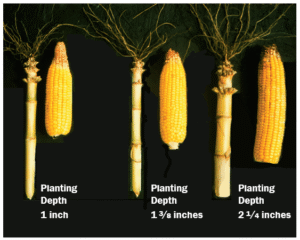 Planting depth.
Long before a corn plant captures sunlight or takes up nutrients, its success is being determined a few inches below the soil surface. How that seed is placed largely dictates how the root system develops, how the plant handles stress, and ultimately how much yield potential it can protect throughout the season.
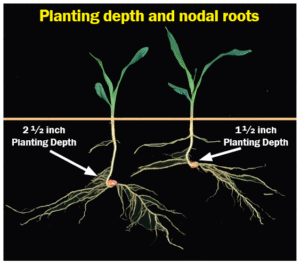
Corn’s early growth stage is less about leaves and more about roots. The first roots that emerge from the seed help anchor the plant and provide early moisture and nutrient uptake, but they are temporary. The real engine of yield comes from the nodal root system that forms at the crown of the plant. Where that crown develops depends almost entirely on planting depth.
When corn is planted between 2 and 2½ inches deep, the crown establishes safely below the soil surface. This positioning protects the growing point from temperature swings, herbicide exposure, and drying conditions while allowing nodal roots to expand into consistent moisture. In modern agronomic terms, proper planting depth allows the plant to transition quickly from survival mode into growth mode.
Problems begin when seed placement becomes inconsistent, particularly when corn is planted too shallow. Seed placed less than 1½ inchs deep often leads to nodal roots forming at or near the soil surface — the most stressful environment the plant will encounter all year. Surface soils warm rapidly during the day, cool quickly at night, and dry out faster than deeper layers. Under these conditions, nodal roots may appear short, stubby, or “clubbed,” and plants may rely heavily on the mesocotyl for support.
These symptoms are frequently mistaken for herbicide injury or fertility issues, yet the underlying cause is often mechanical rather than chemical. Plants may survive, but they rarely perform at their full potential. Shallow-rooted corn is more prone to lodging, uneven growth, and reduced ear development later in the season.
Uniform emergence has become even more critical with modern hybrids and higher planting populations. Today’s genetics respond aggressively to management but also leave less margin for early stress. When plants emerge unevenly because seeds were placed at varying depths, competition begins immediately within the row. Later-emerging plants become permanent underperformers, reducing overall field uniformity and limiting yield potential long before reproductive stages begin.
 Planting too deep can create a different set of challenges. When seed is placed three inches or deeper, the plant must expend additional energy reserves pushing the coleoptile toward the soil surface. In cold, compacted, or crusted soils, the coleoptile may split underground, causing leaves to unfurl before emergence. Even when plants recover, early energy loss can slow development and delay uniform growth across the field.
Because planting depth can vary with soil texture, residue levels, and changing moisture conditions, one of the most valuable agronomic practices remains simply digging plants after emergence. Measuring the mesocotyl length and adding approximately three-quarters of an inch provides a reliable estimate of actual seed depth. Many growers discover that planter settings do not always match field reality, particularly when moving between different soil environments within the same farm.
As agronomy continues to evolve toward soil health, biological efficiency, and improved nutrient cycling, early root development has taken on even greater importance. Strong root architecture supports water infiltration, nutrient uptake, and microbial interaction throughout the season. A plant with a well-positioned crown and aggressive nodal root system is better equipped to handle stress, capture available fertility, and maintain yield stability under variable conditions.
Planting season moves quickly, and efficiency is essential when weather windows open. Still, some of the most profitable management decisions are not the most complex ones. Taking a few moments to verify planting depth across fields can help ensure that every plant begins the season with equal opportunity to succeed.
In many ways, yield potential is established long before tassels appear or combines enter the field. It begins underground, with careful seed placement and a root system positioned to support the crop from emergence through harvest.
Not sure if planting depth is consistent across your fields? Dig a few plants this spring — or let us help. The ProfitProAG team can assist with stand evaluations and early-season diagnostics to make sure your crop starts strong.
Contact Jim Ladlie at 507-383-1325 or Dennis Klockenga at 320-222-1608 if you’d like help evaluating your fields this spring. Sometimes a quick field check can make all the difference for the season ahead.
