
Is Your Water Chemistry Limiting Your Herbicide Performance — Especially When Terminating Cover Crops?
As more farmers adopt cover crops, one question keeps coming up: Why does glyphosate sometimes struggle to deliver a clean, consistent kill — especially on cereal rye?
A podcast I listened to this week hit on something that doesn’t get talked about enough: Glyphosate is a strong chelator of cations.
That means when it enters the plant, it can bind up essential micronutrients like manganese, zinc, copper, and iron — nutrients the plant needs for normal metabolic function. When those nutrients are tied up, the herbicide’s translocation and activity can be reduced.
After hearing that discussion, I reached out to our CCA, Dennis Klockenga, to dig deeper into how this affects real‑world tank mixes. His response was clear:
“Yes, Herbolyte Plus can be used as a tank mix with Roundup for terminating cereal rye. It contains trace elements that Roundup ties up. Roundup is a chelator of cations, especially trace elements like manganese, zinc, copper, and iron.”
This lines up with what many agronomists and university researchers have been saying for years: Water quality and micronutrient availability directly influence herbicide performance.
Why Glyphosate’s Chelation Matters More With Cover Crops
Cover crops — especially cereal rye — are nutrient‑dense plants with high metabolic activity. When glyphosate chelates micronutrients inside the plant, it can slow down the kill, reduce translocation, and lead to inconsistent results.
That’s why adding back trace elements in the tank can support more complete herbicide activity. Herbolyte Plus was designed with this exact challenge in mind.
The Other Big Factor: Water pH and Hardness
Even before glyphosate reaches the plant, water chemistry can make or break herbicide performance.
Dennis explained it well:
“The other advantage with Herbolyte Plus is that it not only decreases the hardness of the water, but it drops the pH of the water. Roundup and most other herbicides prefer a solution pH of 5.5–6. AMS derivatives only correct the hardness and don’t lower the pH.”
Here’s why that matters:
- Hard Water Ions Tie Up Glyphosate
Calcium, magnesium, and other hardness ions bind to glyphosate molecules, reducing absorption and slowing activity.
- Most Herbicides Perform Better in Slightly Acidic Water
Glyphosate, 2,4‑D, dicamba, and many others are more stable and more effective when the spray solution is around pH 5.5–6.
AMS alone can help with hardness, but it does nothing to adjust pH.
Herbolyte and Herbolyte Plus do both.
Where Herbolyte and Herbolyte Plus Fit Into Today’s Spray Programs
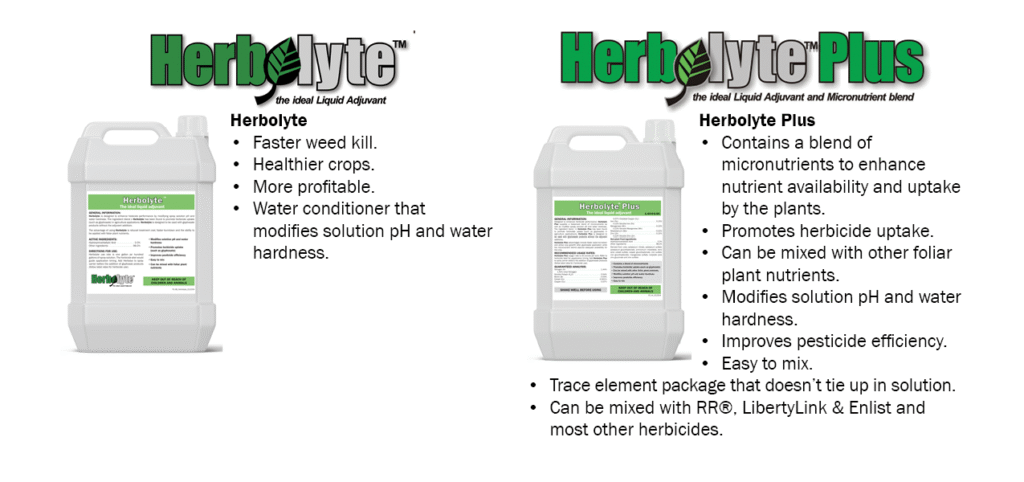
Herbolyte
- Reduces water hardness
- Improves herbicide uptake
- Helps prevent antagonism in the tank
Herbolyte Plus
- All the benefits of Herbolyte
- PLUS added micronutrients to counter glyphosate’s chelation
- Ideal for cover crop termination, especially cereal rye
- Helps maintain optimal spray solution pH
If you’re terminating rye or other vigorous cover crops this spring, Herbolyte Plus is a simple, inexpensive way to protect your herbicide investment and improve consistency.
Bottom Line
Cover crops are here to stay — and so are the challenges that come with terminating them effectively.
Understanding how glyphosate interacts with micronutrients and water chemistry gives you a major advantage.
Herbolyte and Herbolyte Plus help ensure your herbicide works the way it’s supposed to — from the moment it hits the tank to the moment it enters the plant.
If you want help choosing the right product for your spring program, our team is here to help.
Office – 507-373-2550 / info@profitproag.com
Dr. Jim Ladlie – 507-383-1325 / jladlie@profitproag.com
Dennis Klockenga – 320-333-1608 / dklockenga@profitproag.com
Chris Chodur – 507-402-4195 / cchodur@profitproag.com
