
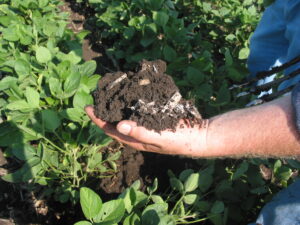
If you’re not using humic acid, now’s the time to start. It’s a key player in soil health and crop yields. Think of humic acid as a multi-tool that stabilizes nitrogen, makes soil nutrients more available to plants, and improves soil structure.
“Humic can make a lot of nutrients more bio-available, especially potassium and phosphorus,” said Cory Ritter, a Midwest regional sales director for Huma®, Inc., which supplies high-quality humic acid for agricultural use.
Humic acid is a naturally occurring substance that’s revolutionizing modern farming practices. Inspired by one of earth’s most precious resources – the organic layer of topsoil known as humus – Huma reflects the strength and resilience of Mother Nature. “Humic acid isn’t new technology, but we’re understanding a lot more about how the science works,” Ritter said.
Humic acid is the result of millions of years of organic matter decomposition. It’s an organic byproduct generated during the early-to-middle stages of coalification—the geological process that transforms plant debris into coal.
“There are only a few humic acid deposits in North America,” said Ritter, who noted that Huma owns mines in New Mexico and Idaho. “Since we control these mines, there’s excellent quality control with our humic acid.”
That’s important to Ritter, who’s also a farmer. “I’m an advocate for soil health and have seen the positive difference humic acid makes,” said Ritter, who farms 2,000 acres in central Illinois, south of Decatur.
Top 5 reasons to use humic acid
Ritter enjoys helping farmers improve their soil health, yields, efficiency, and return on investment (ROI), while prioritizing sustainability. That’s why he’s so bullish on humic acid, which:
- Supplies carbon. Humic acid is a rich carbon source that boosts the beneficial biology in the soil. Carbon is a vital energy source that helps plants make food for beneficial soil microbes, via root exudates. “Humic acid is a starting point for healthy, microbially active soil,” Ritter said.
- Frees up soil nutrients. Humic acid is a biostimulant, not a nutrition source or a biological, Ritter noted. It’s a key to maximizing your fertilizer investment. “Humic acid breaks down the chemical bonds that tie up soil nutrients, making them bio-available for plant uptake.”
- Stabilizes nitrogen. Typical nitrogen stabilizers are “one-trick ponies,” Ritter noted. These products impact the soil biology to inhibit nitrogen breakdown. In contrast, humic acid supports soil microbes as it stabilizes nitrogen. It also makes an array of nutrients more bio-available to plants, so these nutrients are available to crops when they need them.
- Boosts your soil. Humic acid helps reduces soil compaction and creates a more porous soil structure. This allows plant roots to penetrate the soil more easily, which helps crops access water and nutrients more effectively. “Humics perform especially well in heavy clay soils,” Ritter said. “By improving soil structure, humics help water drain better through the soil profile. This allows more air and oxygen into the areas where the plant roots grow.” When soil functions like a “sponge” and manages water more effectively, this also helps mitigate crop stress. “Humic’s impact really shines in stressed environments, especially in dry conditions,” Ritter said.
- Offers an easy-to-use solution. Humic acid can be purchased in a variety of forms, including liquid; granular dry for broadcast spreading; and soluble powder. Dennis Klockenga, CCA, a crops specialist with ProfitProAG, likes the powered form. Mix 1.5 pounds of Huma soluble powder per gallon of water to provide a 12% humic acid solution. When you apply liquid nitrogen, include some humic acid, Ritter added. “This is an inexpensive insurance policy for an expensive input like nitrogen.”
ProfitProAG is ready to help
Humic acid isn’t a quick fix or one-and-done. “It’s a slow-build process,” Ritter said. “It’s a multi-year process that delivers a compound effect over time.”
It also delivers ROI. “I always look at ROI,” Ritter said. “I like how humic acid fits into ProfitProAG’s hands-on approach, which focuses on soil health and long-term gains.”
If you’re ready to see how humic acid can work on your acres, ProfitProAG can help. Huma’s OM Soluble Powder works well with ProfitProAG’s BioEnergy+, BioRegenerate, BioImpact+ products. Huma OM Soluble Powder can be applied with in-furrow, foliar and side-dress nitrogen applications.
