
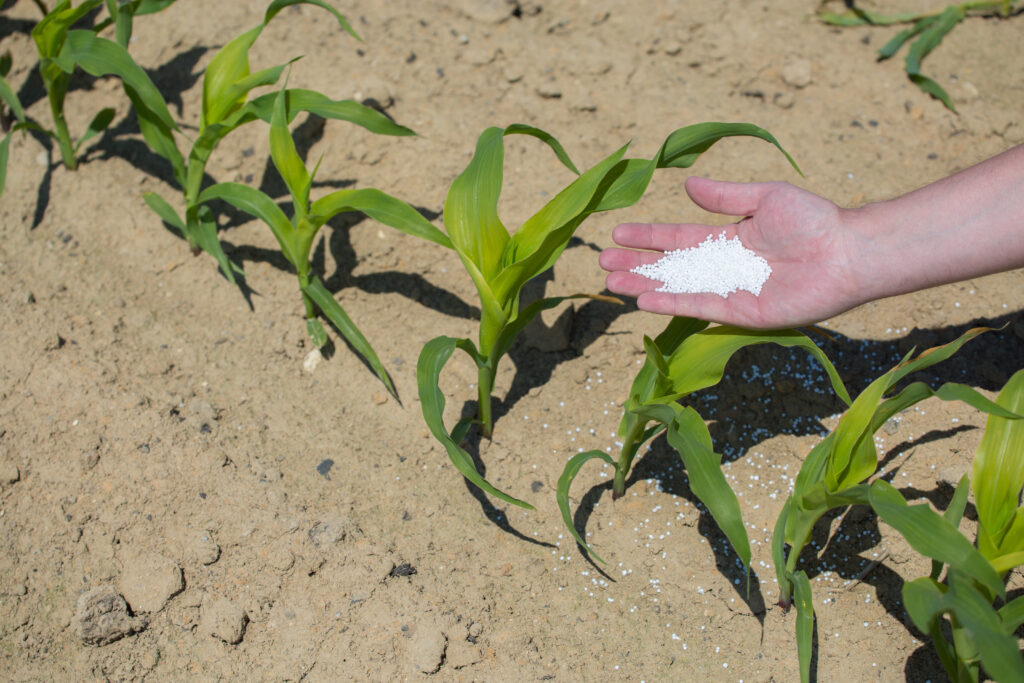
Conventional thinking says more nitrogen (N) equals more yield potential, but is that true? Often there’s too much of a good thing—and not understanding how N really works is costing you.
“Plenty of examples show that the highest-yielding crops don’t have the highest N levels,” says Dennis Klockenga, CCA, a crops specialist with ProfitProAG.
Weeds can thrive in high N systems, though, and gain a competitive advantage over the cash crop. “We need to think differently about managing N from the perspectives of plant health and soil biology,” Klockenga says.
It comes down to how much N is applied and when it’s applied. The key? Don’t put all your N on up front, either in the fall or the spring.
Split-Apply to Maximize Your Fertilizer Investment
The plant’s end goal is to transform the N into amino acids—the building blocks of protein. A corn plant can only process so much N at a time, however.
Apply too much at one time, and you overload the system. The plant can only turn a portion of this N into amino acids and protein. The excess N will remain unused (yes, wasted fertilizer dollars).
At that point, the extra N will go through the nitrification cycle, a biological process that converts the excess N into nitrite and then to nitrate. The nitrate can then leach into the water supply and create other challenges.
Excess nitrate in the water is a hot topic with the Lobe Rangers, a trio of northern Iowa corn and soybean growers who are using social media to encourage better N management. Then there are news headlines like “Des Moines’ Nitrate Removal Facility Has Now Run Almost 90% of 2026,” which appeared in April 2026 on a Des Moines, Iowa, TV station.
“Split-applying N is such a useful management tool, both from an economic and an environmental standpoint,” Klockenga says.
Does “N Gone Wrong” Create Yield Drag?
In crop production, there are two basic forms of N– nitrate and ammonium. “Those two forms of N have fundamentally different impacts on plant physiology,” Klockenga says.
- Nitrate tends to drive vegetative growth. “Corn requires very little N early on,” says Klockenga. The amount required doesn’t increase much until the V3-V6 stages. Too much nitrate early in the growth cycle comes at a cost, due to:
- Weaker plant cell structure
- Higher disease pressure
- Increased insect susceptibility
- Less efficient energy use for grain production
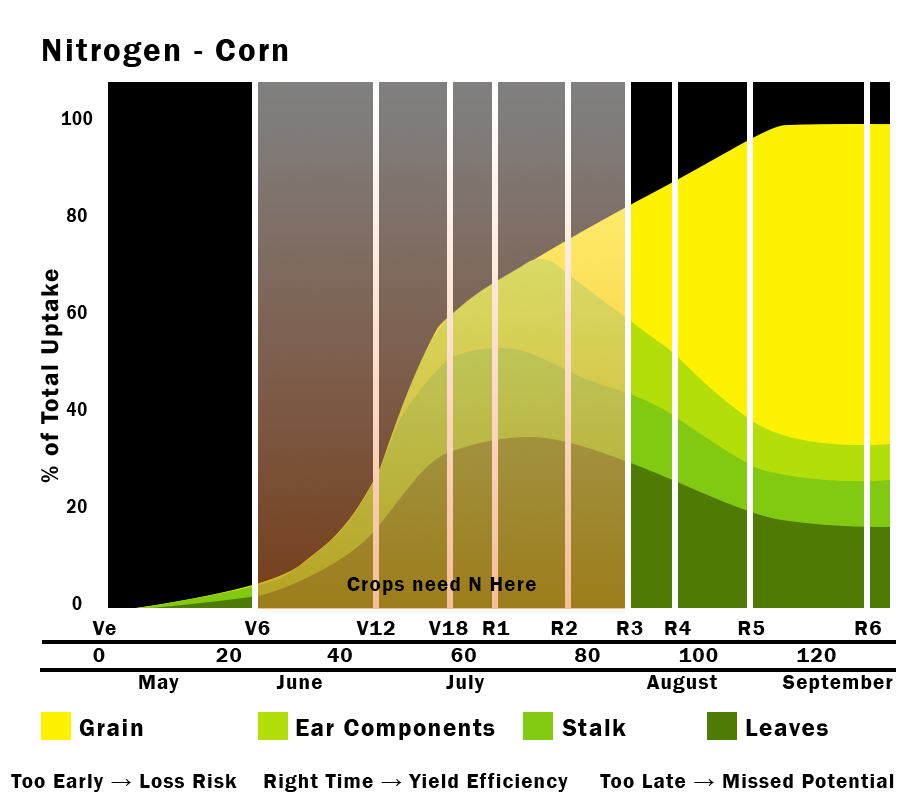 “All this means you have a less healthy plant,” Klockenga says. “Even if the crop looks lush and impressive, that doesn’t always translate that into yield.”
- Ammonium and urea forms of N are great for producing grain. After V5–V6, lower nitrate levels (and more ammonium/urea-based forms) are more beneficial for yield. This is due to plant energy use. Converting nitrate into plant-usable forms requires metabolic energy. When this happens, less energy is available for ear development and grain fill—exactly what you don’t want. “The corn plant needs the right form and amount of N to maximize yield potential,” Klockenga says.
Consider the “During the Adjusting Nitrogen Management” webinar from the Minnesota Soil Health Coalition. “The N for the highest yielding corn was 80% ammonium and 20% nitrate,” says Klockenga, referring to data from John Kempf, founder of Advancing Eco Agriculture and host of the Regenerative Agriculture Podcast.
Water Use, N Forms are Connected
The form of N you supply to your crop can even impact water use efficiency during the growing season.
Plants receiving a high share of N as nitrate can require significantly more water to produce the same yield, compared to plants relying more on ammonium or biologically supplied N forms. In dry conditions, that difference can become quite noticeable in both yield and test weight, Klockenga says.
Anhydrous ammonia (NH3) creates its own challenges regarding water. NH3 is looking for hydrogen molecules to stabilize the product into NH4. “The hydrogen comes from water, which can be found in soil organic matter, beneficial microbes and earthworms in the soil,” Klockenga says. “This chemical process of NH3 seeking hydrogen dries up these beneficials and kills them. You’re torching the organic carbon in the soil where anhydrous is applied.”
Applying anhydrous ammonia is especially problematic when you’re trying to reap the benefits of biologicals like EnSoil Algae™. This liquid product (available through ProfitProAG) helps stimulate beneficial soil microbes for improved nutrient cycling and higher crop yield potential.
It’s counterproductive to add these microbes to your soil, but kill microbes with anhydrous. “We need to look at more eco-friendly, soil-friendly ways to apply forms of N,” Klockenga says.
Soil Biology as a Nitrogen System
N management isn’t just about feeding the crop—it affects the whole field’s ecology.
Healthy soil biology naturally supplies vital plant nutrients, including forms of N. Research from Dr. James White, a professor of plant pathology at Rutgers University, proves that plants can absorb nutrients through interactions with beneficial microbes like bacteria, fungi, and micro algae that thrive in healthy soil.
Compare this to natural ecosystems like prairies and forests. In these areas, plant nutrition cycles through biological systems, rather than synthetic fertilizer inputs. In other words, forms of N and other vital nutrients come from soil biology.
Synthetic fertilizers applied to farmland supply nutrients, but they also add something that can be quite challenging to a biological system—salts. Many conventional fertilizers—including nitrate, ammonium, potassium, and chloride sources—carry a relatively high salt index. High salt or high electrical conductivity (EC) conditions can:
- Suppress beneficial microbial activity
- Stress plant cells
- Disrupt biological nutrient cycling
Counting the Cost
Synthetic fertilizer comes with a cost in more ways than one. To put this in perspective in terms of dollars and cents, let’s figure the cost of commercial N per pound.
Take urea, which was running about $903/ton in Illinois in mid-May 2026. (Urea is 46% N).
2,000 pounds x .46 (N) = 920 lbs. of N in a ton of urea
$903/920 = $0.98 cents/pound
Then run the numbers on 28% N, which was priced around $543 per ton in mid-May 2026.
2,000 pounds x .28 (N) = 560 lbs. of N in a ton of 28%
$543/560 = $0.97/pound
“That means it costs 97 cents per pound of N as 28% N,” Klockenga says. “Historically, we should be closer to 65 to 70 cents per pound.”
3 Practical Take-Aways for Better N Management
With numbers like that, there’s never been a better time to take advantage of the N that’s naturally in your soil. It’s time to stop thinking of N as a single, simple input, Klockenga says. It’s part of a system.
You don’t have to figure all this out by yourself. If you’re looking for an off-ramp from conventional N management and an on-ramp for biology-based plant nutrition, start with three practical steps:
- Be willing to back off on total pounds of N applied. Be open to cutting back by at least 20%, especially if you use EnSoil Algae. This live-cell algae can be tank-mixed and sprayed, either on the soil or through foliar applications. It helps improve grain quality, test weight and yield potential by helping unlock free fertilizer that’s already in the soil. EnSoil Algae can help you reduce your commercial fertilizer by a third—or more.
- Use split applications during the growing season. Instead of fall-applying N, put on a couple applications of N closer to the start of the planting season and during the growing season. Side-dressing with y-drops is a good option. “Your application will be much more effective, because it’s readily available when the growing crop needs it,” Klockenga says. These management practices also help prevent leaching and protect the environment, he adds.
- Test for Water Extractable Organic Carbon (WEOC) and Water Extractable Organic Nitrogen (WEON) with the Haney test. Think you could drop N to less than a pound per acre—or even lower—without hurting your return on investment (ROI)? Use the Haney test, which has been called the only soil test that’s designed to directly reduce fertilizer applications. Managing N more effectively is the biggest way you can save money using the Haney test.
The Haney test tracks WEOC. This measures the microbes’ food source—specifically organic carbon. WEOC is a smaller fraction of the total soil organic matter. “The higher the WEOC, the better microbial activity you have in your soil,” Klockenga says. Most soils fall in the 100 to 300 parts per million (ppm) range. Manure and cover crops can elevate WEOC.
You can also use the Haney test to measure WEON. This organic N is in the form of proteins and amino acids that are available to microbes. Most soils are in the range of 10 to 30 ppm. A WEON of 30 ppm is equivalent to 60 pounds of N.
Let’s Talk
The bottom line? N is costly, and getting the best ROI starts with knowledge.
If you’re ready to find ways to fine-tune your N and get more for your buck, Klockenga and the ProfitProAG team are ready to help.
